
Introduction: Defining the ‘Bulldog’ in High-Stakes Litigation

For startup founders, legal challenges can be a significant threat. High-stakes legal battles can put a company’s very existence at risk. In such critical moments, a specific kind of legal expert can be a startup’s greatest asset.
This article will define what makes a “bulldog” litigator. It will explore their aggressive and proactive strategies. Readers will learn how these lawyers defend a startup’s interests. It will explain when an aggressive approach is necessary. Finally, it will show how this strategy can lead to successful results in difficult legal disputes.
The Core Traits of a Bulldog Litigator

A “bulldog” litigator is not merely an attorney who argues cases in court; they embody a strategic, tenacious approach to legal disputes that prioritizes their client’s interests above all else. Their effectiveness stems from a combination of relentless preparation, strategic aggression, and an unwavering focus on achieving a decisive victory. This type of lawyer understands that in high-stakes business litigation, every move matters, and a passive stance can often be as detrimental as a misstep.
Relentless preparation is the bedrock of their strategy. A bulldog litigator leaves no stone unturned, carefully researching every detail, precedent, and potential angle of a case. They dig deep into the facts, anticipate opposing counsel’s arguments, and build an unassailable foundation for their client’s position. This exhaustive preparation ensures they are always one step ahead, ready to counter any challenge with well-reasoned arguments and compelling evidence.
Strategic aggression is another hallmark. This isn’t about being overtly hostile or unprofessional, but rather about asserting the client’s rights and position with force and conviction. It involves taking decisive action, whether through filing robust motions, demanding critical findy, or challenging opposing claims vigorously. Their aggression is calculated, designed to apply pressure, expose weaknesses in the adversary’s case, and control the narrative of the dispute.
Courtroom dominance is often a natural outcome of their preparation and strategic aggression. When a bulldog litigator steps into court, they command attention. Their arguments are sharp, their cross-examinations incisive, and their presence authoritative. They are adept at presenting complex legal concepts in an understandable and persuasive manner, influencing judges and juries alike.
Beyond the courtroom, they are master negotiators. While known for their litigation prowess, a bulldog litigator understands that sometimes the best victory is achieved outside of court. They leverage their strong position, built through meticulous preparation and strategic aggression, to dictate favorable settlement terms. They are skilled at protecting business assets and maximizing outcomes, often avoiding protracted legal fights that can drain a startup’s resources. Their unwavering focus on the client’s long-term objectives guides every negotiation, ensuring that any resolution aligns with the startup’s strategic goals. They also excel at risk assessment, constantly evaluating the potential downsides and upsides of various legal paths, providing clear, actionable advice to their clients. This comprehensive approach to dispute resolution makes them an indispensable asset.
The Mindset of Strategic Aggression
The core of a bulldog litigator’s approach lies in a distinct mindset: one of strategic aggression. This isn’t about uncontrolled anger or unprofessional conduct; rather, it’s a calculated, disciplined application of legal force designed to achieve specific objectives. Tenacity is paramount; they simply do not give up. They pursue every lead, challenge every misrepresentation, and fight for every advantage, understanding that legal battles are often marathons, not sprints.
This tenacity is paired with calculated pressure. Bulldog litigators understand how to apply pressure points in a case, whether through aggressive findy requests, early motion practice, or strategic public statements (where appropriate and ethical). This pressure is intended to make the opposing party uncomfortable, forcing them to re-evaluate their position and potentially concede. By controlling the narrative, they shape how the dispute is perceived, both in and out of court. They frame the issues in a way that favors their client, influencing public opinion, potential jurors, and even the judge.
A key element is forcing opponent errors. By being exceptionally prepared and strategically aggressive, they often provoke mistakes from less prepared or more passive opponents. These errors can be procedural, factual, or strategic, and a bulldog litigator is quick to capitalize on them to their client’s advantage. This creates a psychological advantage, as opponents quickly learn that facing this type of litigator means a tough, uphill battle, which can itself lead to concessions.
Beyond the Courtroom: Leveraging Aggression in Negotiations
While their reputation for courtroom battles precedes them, a bulldog litigator’s aggressive mindset is equally powerful in negotiation settings. They enter discussions with a clear understanding of their client’s strengths and the opponent’s weaknesses, using this knowledge to create leverage. This might involve highlighting the potential costs and risks for the other side if the case proceeds to trial, or showcasing the strength of their client’s evidence.
Their objective is to dictate settlement terms, rather than simply accepting what’s offered. They push for terms that are not just acceptable, but truly advantageous to their client, protecting business assets and future interests. This proactive stance often avoids protracted legal fights, saving the startup significant time, money, and emotional energy. By demonstrating a willingness and capability to go to trial, they often secure more favorable out-of-court settlements, maximizing outcomes that align with the startup’s long-term vision and financial health. They understand that a strong negotiation position is built on credible threats and a proven track record of successful litigation.
When Do You Need an Aggressive Litigation Strategy?

Not every legal issue warrants an aggressive litigation strategy, but in certain high-stakes scenarios, it becomes not just beneficial, but essential. Startups, despite their innovative spirit and rapid growth, are particularly vulnerable to legal challenges that can derail their progress or even lead to their demise. These challenges often involve core assets, foundational agreements, or existential threats that demand a robust, proactive defense.
Common scenarios where an aggressive litigation strategy is crucial include:
- Intellectual Property Theft: For many startups, their intellectual property (IP) – patents, trademarks, copyrights, trade secrets – is their most valuable asset. If a competitor or former employee steals or infringes upon this IP, a passive response can lead to irreparable harm. An aggressive litigator will move swiftly to secure injunctions, pursue damages, and protect the startup’s innovations.
- Breach of Fiduciary Duty: This often arises in disputes among co-founders, board members, or key executives where one party has acted against the best interests of the company. Such breaches can undermine trust and destabilize the entire organization, requiring decisive legal action.
- Shareholder Disputes: As startups grow and take on investors, disagreements among shareholders regarding control, valuation, or strategic direction can escalate. An aggressive litigator can protect the interests of the majority or minority shareholders, ensuring the company’s stability.
- Mergers & Acquisitions Disputes: M&A deals are complex, and disputes can arise at any stage, from due diligence to post-closing indemnification claims. An aggressive approach can protect the startup’s value and ensure deal terms are honored.
- Partnership Dissolutions: When business partnerships sour, an aggressive litigator can ensure an equitable separation, protecting the startup’s assets and future viability during a potentially contentious process.
- Unfair Competition: This can include deceptive advertising, poaching key employees, or other anti-competitive practices by rivals. A strong legal response is necessary to level the playing field and prevent ongoing damage.
Even a promising new venture can face existential threats from litigation, making a Bulldog startup business lawyer with litigation prowess an invaluable ally from the outset. Such a lawyer ensures that the startup is not just reactive but proactive in safeguarding its future against legal onslaughts.
Assessing the Stakes: When to Release the Bulldog
Deciding when to deploy an aggressive litigation strategy requires a careful assessment of the stakes involved. The “bulldog” should be releaseed when the very existence of the business is threatened. This includes situations where a legal challenge could lead to bankruptcy, the loss of critical intellectual property, or the inability to continue operations. For a startup, these are often “bet-the-company” scenarios that demand the most formidable legal defense available.
Significant financial exposure is another trigger. If a lawsuit or dispute could result in damages so substantial that they cripple the company’s finances, an aggressive approach is warranted. This involves not just defending against claims but also pursuing counterclaims or leveraging settlement opportunities to mitigate financial risk.
Protecting core assets goes beyond just IP. It can include proprietary technology, key customer relationships, essential contracts, or even the company’s reputation. When these vital components are under attack, a passive legal strategy risks their erosion or complete loss. An aggressive litigator acts as a guardian, fighting fiercely to preserve what makes the startup valuable.
Finally, setting a legal precedent can be a crucial factor, especially for innovative startups operating in new or evolving markets. A victory in a high-stakes case can establish favorable legal interpretations, deter future challenges, and solidify the company’s position in the industry. Losing, or settling poorly, can set a dangerous precedent that invites further legal challenges.
The Risks of a Passive Approach in High-Stakes Fights
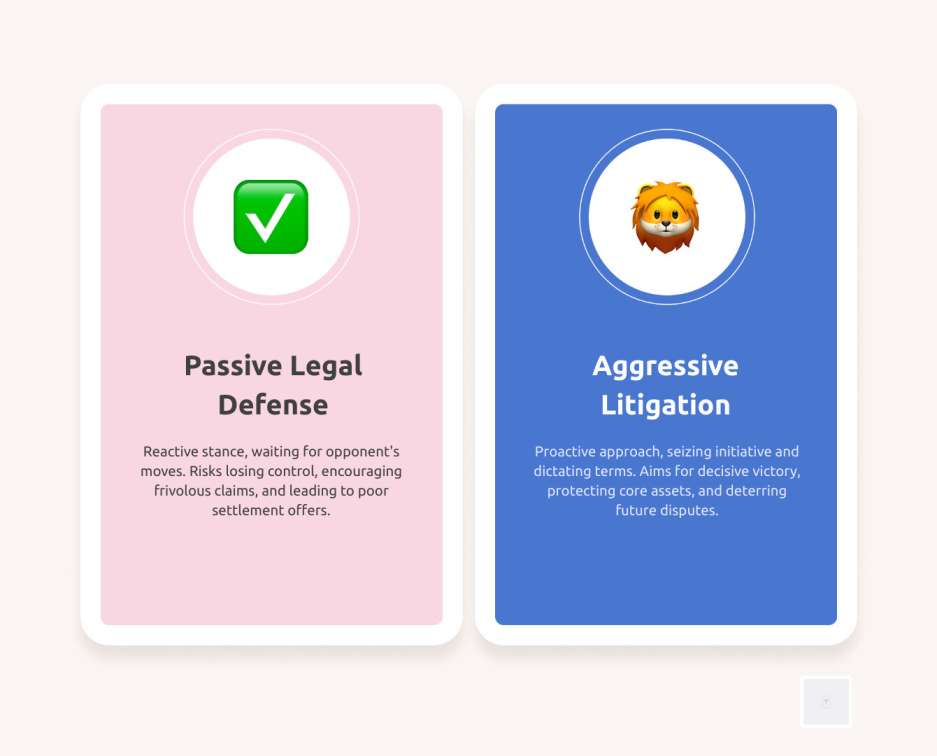
In high-stakes litigation, a passive legal approach can be incredibly perilous, often leading to outcomes far worse than those faced by a proactive, aggressive defense. One of the most immediate risks is losing control of the narrative and the litigation process itself. When a party is passive, the opposing side dictates the pace, scope, and direction of the case, putting the passive party constantly on the defensive.
Appearing weak is another significant drawback. A lack of forceful response can signal to the adversary that the startup is either unwilling or unable to mount a strong defense. This can embolden the opposing party, making them less likely to offer reasonable settlement terms and more likely to press their claims aggressively. This perceived weakness can also encourage frivolous claims, as other parties might view the startup as an easy target.
The consequence of appearing weak often translates into poor settlement offers. If the opposing counsel believes they can easily win at trial, or that the startup is desperate to avoid litigation, they will offer terms that are heavily skewed in their favor, leaving the startup with little recourse but to accept unfavorable conditions or face a costly trial from a disadvantaged position.
Furthermore, a passive approach risks damaging the startup’s reputation. In the business world, a company’s ability to protect its interests and stand firm against challenges is often a measure of its strength and reliability. A history of being pushed around in legal disputes can erode trust among investors, partners, and customers, impacting future growth and opportunities. While aggression must be strategic, passivity in a high-stakes battle is almost always a losing proposition.
The Strategic Advantages of a Proactive Litigation Stance
Adopting a proactive litigation stance, spearheaded by a bulldog litigator, offers numerous strategic advantages that can profoundly impact the outcome of high-stakes disputes for a startup. This approach transforms defense into offense, allowing the startup to seize the initiative rather than merely reacting to the adversary’s moves.
By being proactive, the startup gains the ability to control the pace of litigation. This means initiating findy, filing motions, and setting deadlines that align with the startup’s strategic objectives, rather than being dragged along by the opposing party. This control can be crucial in managing costs, preserving resources, and maintaining focus on core business operations.
A proactive stance significantly increases settlement leverage. When a startup demonstrates a clear intent and capability to vigorously pursue its claims and defend its interests, it signals strength to the opposing party. This often leads to more favorable settlement offers, as adversaries recognize the high cost and risk of facing a well-prepared and aggressive opponent in court.
Moreover, proactive findy—the process of exchanging information between parties—allows a bulldog litigator to uncover opponent weaknesses efficiently. By aggressively seeking out relevant documents, interrogating witnesses, and conducting depositions, they can identify critical flaws in the adversary’s case, which can then be exploited to the startup’s advantage.
A proactive litigation stance is about protecting long-term business interests. It’s not just about winning the current battle, but about safeguarding the startup’s reputation, market position, and future growth trajectory. By resolving disputes decisively and favorably, the startup can minimize distractions and focus on innovation and expansion.
How Proactive Aggressive Litigation Shapes Outcomes
Proactive aggressive litigation is not just about winning; it’s about shaping the entire trajectory of a legal dispute to achieve the most beneficial outcome for the client. Here are some key advantages:
- Forcing Early Resolution: By demonstrating a strong, well-prepared position from the outset, a bulldog litigator can often compel the opposing party to consider settlement earlier than they might otherwise. The prospect of a prolonged, costly battle against a formidable opponent can be a powerful motivator for early resolution, saving the startup significant time and legal fees.
- Deterring Future Litigation: A decisive victory or a highly favorable settlement achieved through aggressive litigation sends a clear message to potential future adversaries. It establishes the startup as a company that will vigorously defend its rights and assets, making it a less attractive target for frivolous lawsuits or opportunistic challenges.
- Preserving Capital: While litigation can be expensive, a proactive and aggressive approach can often be more cost-effective in the long run. By forcing early resolutions and deterring future disputes, it prevents the continuous drain of resources that can come from prolonged or repeated legal battles. Moreover, securing favorable terms in settlements or judgments directly contributes to capital preservation.
- Demonstrating Strength to the Market: In the eyes of investors, partners, and customers, a startup’s ability to effectively steer and win legal disputes is a sign of its resilience and strategic acumen. A strong legal defense, particularly in high-stakes cases, improves the company’s credibility and demonstrates its commitment to protecting its innovations and business model. This can be crucial for fundraising, securing partnerships, and attracting top talent.
Case Study: Turning the Tables with a Counter-Offensive
Consider a hypothetical scenario: InnovateTech, a burgeoning AI startup, finds itself sued by a larger, established tech giant, GlobalCorp, for alleged patent infringement. GlobalCorp, with its vast legal resources, aims to stifle InnovateTech’s disruptive technology and eliminate a competitor. Initially, InnovateTech’s legal team adopts a defensive posture, responding to GlobalCorp’s claims. However, the bulldog litigator, brought in for their aggressive strategy, quickly identifies a critical opportunity.
Through meticulous findy, the bulldog litigator uncovers evidence that GlobalCorp itself has been infringing on a lesser-known patent held by InnovateTech, one that underpins a key feature in GlobalCorp’s own flagship product. This shifts the dynamic dramatically.
InnovateTech’s legal team, under the guidance of the bulldog litigator, immediately files a robust counterclaim against GlobalCorp for patent infringement. This move, a strategic counter-offensive, transforms InnovateTech from a defendant solely on the defensive to an aggressor with significant leverage. The pressure on GlobalCorp intensifies; they are now facing not only the costs of defending their original lawsuit but also the potential for substantial damages and an injunction against their own product.
This aggressive use of counterclaims effectively turns the tables. GlobalCorp, which initially sought to crush InnovateTech, now faces an existential threat to its own revenue stream. The bulldog litigator leverages this new position to negotiate from strength. Instead of a costly trial, GlobalCorp is compelled to enter serious settlement discussions. The outcome is a favorable settlement for InnovateTech, including a licensing agreement for their technology, a substantial monetary payment, and the dismissal of GlobalCorp’s original infringement claims. This case study illustrates how shifting from defense to offense through strategic counterclaims, guided by an aggressive litigator, can achieve a favorable verdict or settlement that not only protects the startup but also propels its growth.
Frequently Asked Questions about Aggressive Litigation
Is aggressive litigation always the best approach?
While the benefits of an aggressive litigation strategy are clear in high-stakes scenarios, it is crucial to understand that it is not a one-size-fits-all solution. The decision to employ such an approach must stem from a careful strategic assessment and a thorough cost-benefit analysis. An experienced bulldog litigator will not simply be aggressive for aggression’s sake; they will evaluate the specific facts of the case, the client’s objectives, the financial implications, and the potential for alternative dispute resolution (ADR).
ADR methods, such as mediation and arbitration, can often provide a more cost-effective and time-efficient path to resolution. In mediation, a neutral third party helps facilitate a settlement, while in arbitration, a neutral third party hears both sides and makes a binding decision. These options can be particularly attractive when the legal costs of litigation threaten to outweigh the potential recovery or defense.
However, when diplomacy fails, and the opposing party is unreasonable, uncooperative, or clearly intent on harming the startup, an aggressive litigation strategy becomes indispensable. It is about understanding when to negotiate and when to fight, and having the legal firepower to do both effectively. A skilled litigator knows when to be a diplomat and when to release the bulldog.
What is the typical cost of hiring a bulldog litigator?
The cost of hiring a highly skilled litigator, particularly one known for their aggressive and effective approach, can vary significantly. Generally, legal fees for business attorneys can range widely depending on several factors: the attorney’s experience, the complexity of the case, the firm’s reputation, and geographic location.
According to industry statistics, you can typically expect to pay between $150 and $325 an hour for a small business attorney. However, for complex, high-stakes litigation requiring a “bulldog” approach, rates can be considerably higher, sometimes exceeding $1,000 per hour for senior partners at prestigious law firms.
Fee structures for litigators often include:
- Hourly Rates: The most common structure, where you are billed for the actual time spent by the attorney and their team.
- Retainers: An upfront payment to secure the attorney’s services, which is then drawn down as work is performed.
- Contingency Fees: Rare in business defense litigation, where the attorney receives a percentage of the amount recovered. This is more common in personal injury or certain plaintiff-side commercial cases.
For startups, managing legal costs is a critical concern. While the hourly rates might seem daunting, view the expense of a top-tier litigator as an investment rather than just a cost. The value they bring through strategic victories, favorable settlements, and the protection of core assets can far outweigh the fees. The “cost of losing” a high-stakes battle—in terms of lost IP, damaged reputation, or financial ruin—is often far greater than the expense of hiring the best possible defense. Some attorneys or firms may offer alternative fee arrangements for startups, such as fixed fees for certain stages or blended rates, but these are less common in complex litigation.
How do I find a litigator with the right kind of aggressive approach?
Finding a litigator with the right “bulldog” approach requires diligence and a clear understanding of your specific needs. It’s not just about finding someone aggressive, but someone strategically aggressive, effective, and ethical. Here are key steps:
- Check Their Track Record: Look for attorneys with a proven history of success in similar high-stakes cases. This includes favorable judgments, significant settlements, and successful defense of clients facing existential threats. Don’t be afraid to ask for specific examples of their work.
- Evaluate Trial Experience: A true bulldog litigator has extensive trial experience. They are comfortable and effective in the courtroom, not just in negotiation. Ask about their experience in front of judges and juries, and their win-loss record in contested matters.
- Seek Client Testimonials and Referrals: Speak to other business owners, especially those who have faced complex litigation. Personal referrals from trusted sources can be invaluable. Look for testimonials that highlight the attorney’s tenacity, strategic thinking, and ability to deliver results under pressure.
- Schedule an Initial Consultation: Most reputable litigators offer an initial consultation. Use this opportunity to assess their strategic philosophy. Ask them how they would approach your specific case, what their proposed strategy would be, and what potential challenges they foresee. Pay attention to their communication style, their understanding of your industry, and whether their approach aligns with your comfort level and objectives.
- Inquire About Their Strategic Philosophy: Ask direct questions about their definition of “aggressive” litigation. Do they prioritize early settlement, or are they prepared to go the distance? How do they balance assertiveness with professionalism? A good litigator will explain their approach clearly and demonstrate how it serves the client’s best interests.
- Assess Their Team: Litigation is often a team effort. Understand who else in the firm would be working on your case, their experience levels, and how the team collaborates to support the lead litigator.
By thoroughly vetting potential candidates based on these criteria, a startup can identify a litigator who possesses the strategic acumen and relentless drive necessary to protect their interests in even the most challenging legal battles.
Conclusion: Your Strongest Shield in a Business War
In a high-stakes legal battle, a bulldog litigator is not just a lawyer; they are a strategic weapon. Their proactive, relentless approach can be the deciding factor between a catastrophic loss and a decisive victory, protecting the business you’ve worked tirelessly to build.
Leave a Reply