
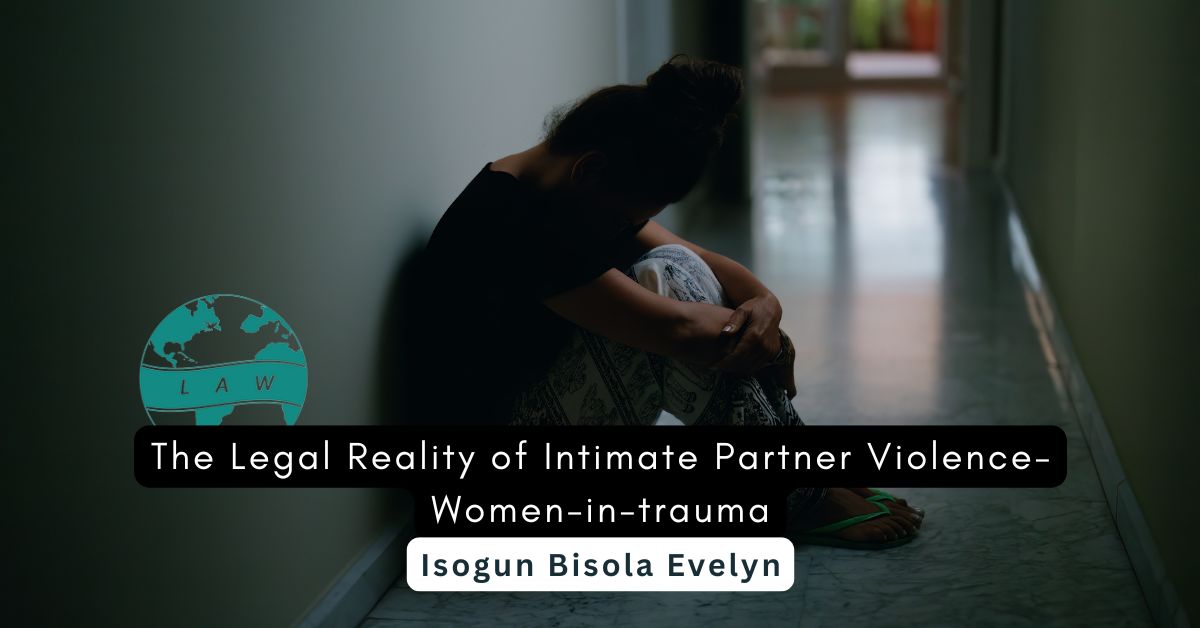
The Legal Reality of Intimate Partner Violence- Women-in -trauma
‘All I have ever done was loved you when I was 8teen’
For many, the doors of a home is a shield against the whole world but for a victim of intimate partner violence, this same door is an obstacle. Section 34 of the constitution of federal republic of Nigeria 1999(as amended) provides for the right to dignity of human person.
That is, no person should be subject to inhumane and degrading treatment whatsoever. Likewise, Section 42 of the 1999 constitution provides for right to discrimination based on sex.
According to Black’s law dictionary, domestic violence is defined as “Violence between members of the same household, regardless of the specific relationship, especially physical abuse between a husband and wife or between people who lives together as if married.”
While intimate partner violence is a sub-category of domestic violence, they are interchangeably used. The distinction, however lies in their scope. While domestic violence is broad and inclusive of the entire household, Intimate partner violence is specific to romantic or sexual partners.
Section 46 of the Violence Against Persons (Prohibitions) Act (VAPP) 2015 also provides for the definition of abuse and violence as well as the various forms of abuse ranging from physical, sexual, to emotional abuse.
Evan Stark, perhaps the most influential scholar on IPV argues that violence is only one tool. He defines IPV as a “coercive control strategy- a malevolent, ongoing course of conduct intended to dominate and entrap a partner by restricting their freedom and autonomy.”
Stark argues that IPV should be understood as a liberty crime rather than just a physical assault or fight. Thus, Intimate partner violence is a conglomerate of the various forms of abuse ranging from physical, emotional, sexual and mental abuse and also a pattern of domination that includes stalking, isolation and financial control between romantic or sexual partners.
In the rural areas, IPV, is often more pervasive than in urban areas yet it remains significantly unreported due to deep-seated cultural norms and physical isolation. The stigma associated with victims of this abuse is deeply rooted in its trivial reception. Most times, victims are advised to endure, often citing examples of another person having it worse than them.
They say love is sacrificial even if it means losing all they have and that includes themselves- their self-esteem, confidence, sanity and sometimes even their life. Globally, about 30% of women have experienced physical or sexual IPV. In the African region, this estimate goes higher at approximately 33-36%.
In some rural southeast Nigerian communities, prevalence rates as high as 97% have been recorded in specific localized studies, compared to 81% in neighboring rural areas. A study in southwest Nigeria found that 28% of rural women experienced physical violence compared to 14% of urban women.
IPV is not caused by a single factor. It is a combination of individual, relationship, community and societal influences, more often nonchalance. It emanates from the patriarchal ideology which is a deeply ingrained beliefs that men have a right to discipline their partners.
This is often reinforced by religious texts or cultural traditions. Section 55(1)(d) of the Nigerian penal code provides that “Nothing is an offense which does not amounts to the infliction of grievous hurt upon any persons which is done.” This section allows a husband for the purpose of ‘correcting’ his wife, provided they are subject to a custom where such correction is recognized as lawful, and it does not amount to grievous hurt. It is absurd that a section of the law that is supposed to protect every person grants legal cover to ‘discipline’ women as long as the violence does not result in broken bones or open wounds.
Another cause of IPV is social acceptance of violence. In some communities, especially rural ones, physical correction is seen as a private family matter to be discussed in sitting rooms rather than addressing it as the crime it is. IPV is frequently tolerated or justified within families, particularly in rural or low-resource settings, as a means of controlling women. It is widely believed that dispute should be settled between the couples and family.
Thus, victims or survivors of abuse do not report their experiences and seek help. Some established factors for non-reporting of IPV by women include: financial dependence on partner, involvement of children, stigma and shame, lack of social supports, fear of partner, cultural beliefs, young age, acceptance of violence among others.
To mitigate the alarming rate of IPV in the society, the approach must be multi-faceted, addressing the legal, social and economic structures that allow it to persist. IPV is not caused by a singular thing, therefore, its solution lies not in a singular action. These solutions include:
- Domestication and Harmonization of VAPP Act: while the VAPP Act condemns and provides sanctions for abusers, its implementation is uneven. Ensuring every state, including those in the North, domesticates and funds the act to increase its application and functionality.
- Repeal of discriminatory statutes: To mitigate intimate partner violence and violence/abuse in its entirety, there’s an urgent need to repeal section 55 of the penal code and similar provisions in sharia or customary laws that provides justification for spousal battery and tilts towards patriarchal appraisal rather than natural justice and humanity.
- Police training: police sensitization and training to treat IPV cases as a criminal breach rather than private civil matter or family dispute.
- Training judges to understand coercive control so they can grant protection orders even when physical injuries are not present.
- Research shows that providing women with financial literacy alongside relationship skills training or couples significantly reduces IPV. Increasing state-funded shelters, particularly in rural areas, to provide an immediate exit point for those in danger also proves to reduce the cases of IPV.
Conclusively, Intimate partner violence is not just mere existing word, it is the harsh reality of many women in “love” out there. And as long as discriminatory and inhumane sections like Section 55 of the penal code Act exists, and rural enforcement is weak, the right to dignity under Section 34 of the constitution remains an unfulfilled promise for many.
IPV is not a private or disciplinary matter and should never be treated as such because love, in the eyes of the law, should be a partnership of equals, not a license for domination and degradation. Hence, to move from a culture of trauma to a culture of healing, the law must finally recognize that a woman is a person to be protected, not a punching bag to be corrected.
We must dismantle the patriarchal norms that justify abuse as correction. Justice demand that we close the gap between the statutes in our books and the safety in our homes.
References
Constitution of the Federal Republic of Nigeria 1999 (as amended), s. 34 & 46.
Violence Against Persons (Prohibition) Act, 2015, s.46
Penal Code Law, Laws of the Northern States of Nigeria, 1963, s. 55(1)(d)
Black’s law dictionary.
About Author
Isogun Bisola Evelyn is a 400-level law student from Ekiti state university. The areas of law that sparked her interest includes Criminal law, Equity and Trusts, Corporate and Intellectual Property law.
She is passionate Youth development, mental and women health while serving as a volunteer in various capacities. She has served as the Court clerk of Eksu Student Judicial Council. She is a senior law clinician in the EKSU Faculty of law serving in the community outreach and media team.

Leave a Reply