
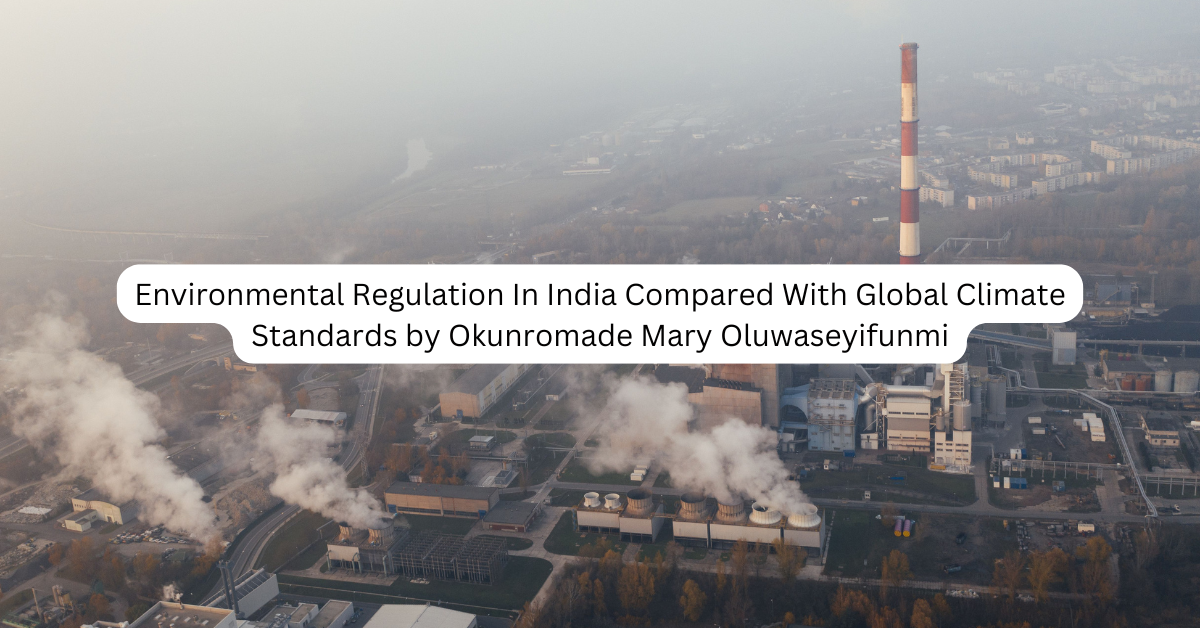
Environmental Regulation In India Compared With Global Climate Standards
Background of the Indian Law or Policy
Environment Protection Act, 1986 is an Act of the Parliament of India. It was enacted in May 1986 and came into force on 19 November 1986. It has 26 sections and 4 chapters. The Act is widely considered to have been a response to the Bhopal gas leak. The Act was passed by the Government of India under the Article 253 of the Constitution of India, which empowers to union government to enact laws to give effect to international agreements signed by the country. The purpose of the Act is to implement the decisions of the United Nations Conference on the Human Environment. They relate to the protection and improvement of the human environment and the prevention of hazards to human beings, other living creatures, plants and property. The Act is an “umbrella” legislation that has provided a framework for the environmental regulation regime in India, which covers all major industrial and infrastructure activities and prohibits and regulates specific activities in coastal areas and eco-sensitive areas. The Act also provides for coordination of the activities of various central and state authorities established under other environment-related laws, such as the Water Act and the Air Act.
The Central Pollution Control Board (CPCB) of India is a statutory organization under the Ministry of Environment, Forest and Climate Change (Mo.E.F.C.C.). It was established in 1974 under the Water (Prevention and Control of pollution) Act, 1974. The CPCB is also entrusted with the powers and functions under the Air (Prevention and Control of Pollution) Act, 1981. It serves as a field formation and also provides technical services to the Ministry of Environment and Forests under the provisions of the Environment (Protection) Act, 1986. It coordinates the activities of the State Pollution Control Boards by providing technical assistance and guidance and also resolves disputes among them. It is the apex organization in country in the field of pollution control,[3] as a technical wing of MoEFCC.[4][5] The board is led by its chairperson appointed by the Appointments Committee of the Cabinet of the Government of India.[6] The current acting chairman is Amandeep Garg IAS (Jan 2025) and the Member Secretary is Bharat Kumar Sharma.
The vulnerability assessment and adaptation studies of climate change were made in various areas such as water resources, agriculture, forests, natural eco-systems, coastal zones, health energy and infrastructure as a part of the Initial National Communication of India2 to the United Nations Framework Convention on Climate Change (UNFCCC). Further, the Expert Committee on Impact of Climate Change set up by the Ministry of Environment & Forests in June 2007 assessed the impact of climate change on six areas, namely water resources, agriculture, Natural Ecosystem, Health, Coastal Zone Management and Climate modelling. Reports of the Expert Committee were then prepared and a range of policies and programmes were initiated to address the problem of climate change in the context of sustainable development.
Comparative and Global Analysis
The Paris Agreement is a legally binding international treaty on climate change. It was adopted by 195 Parties at the UN Climate Change Conference (COP21) in Paris, France, on 12 December 2015. It entered into force on 4 November 2016. Currently, as of 27 January 2026, there are 194 Parties to the Paris Agreement. Its overarching goal is to hold “the increase in the global average temperature to well below 2°C above pre-industrial levels” and pursue efforts “to limit the temperature increase to 1.5°C above pre-industrial levels.” However, in recent years, world leaders have stressed the need to limit global warming to 1.5°C by the end of this century. That’s because the UN’s Intergovernmental Panel on Climate Change indicates that crossing the 1.5°C threshold risks unleashing far more severe climate change impacts, including more frequent and severe droughts, heatwaves and rainfall. To limit global warming to 1.5°C, greenhouse gas emissions must peak before 2025 at the latest and decline 43% by 2030. The Paris Agreement is a landmark in the multilateral climate change process because, for the first time, a binding agreement brings all nations together to combat climate change and adapt to its effects.
Policy Issues and Challenges
Electricity in India is the third-largest producer and consumer of electricity globally after China and the United States. In FY 2024-25, the country generated 1824 TWh of power, of which 25% came from non-fossil sources.[7] India has achieved near-universal household electrification, though the quality and reliability of supply remain uneven across regions.
in India is generated by both public and private sector utilities, transmitted through a unified national grid, and distributed primarily by state-owned distribution companies. The sector has undergone significant reforms since the Electricity Act of 2003, which introduced competition, open access, and independent regulation. Despite rapid growth in generation and transmission capacity, the distribution segment continues to face financial stress due to high technical and commercial losses, tariff constraints, and subsidy burdens.
India has also emerged as a global leader in renewable energy deployment, with renewables accounting for 89% of capacity additions in FY 2024-25.[9] The country has set ambitious targets to achieve 500 GW of non-fossil fuel capacity by 2030[10] as part of its transition toward a low-carbon energy system.
Recommendations
India should strengthen its environmental governance by adopting a legally binding climate framework aligned with the Paris Agreement. This framework should include enforceable emission targets and carbon budgets. Institutional capacity must improve by empowering the Central Pollution Control Board with stronger enforcement powers, digital monitoring systems, and stricter penalties for non-compliance. Reforms in the electricity sector are critical. Key steps include reducing transmission losses, restructuring subsidies, and improving the financial stability of distribution companies under the Electricity Act 2003. India should also establish a national carbon market under the Energy Conservation Amendment Act 2022 to encourage emission reductions. Finally, policies should speed up the expansion of renewable energy and follow global best practices by ensuring transparency, accountability, and the integration of climate goals into all sectors.
Conclusion
India’s environmental framework, led by the Environment Protection Act of 1986, offers a wide-ranging regulatory base but struggles with enforcement and binding climate obligations. Although there has been notable progress in renewable energy and electrification, there are still gaps in implementation, coordination among institutions, and long-term sustainability. It is essential to align domestic laws with global standards to improve accountability and climate resilience. Future reforms will shape India’s ability to balance economic development and environmental protection while influencing its role in global climate governance.
References
1. Environment Protection Act 1986
Environment (Protection) Act 1986 (India).
2. Central Pollution Control Board
Central Pollution Control Board, About CPCB.
3. Water (Prevention and Control of Pollution) Act 1974
Water (Prevention and Control of Pollution) Act 1974 (India).
4. Air (Prevention and Control of Pollution) Act 1981
Air (Prevention and Control of Pollution) Act 1981 (India).
5. United Nations Framework Convention on Climate Change
UNFCCC, India National Communication Reports.
6. Paris Agreement
7. Intergovernmental Panel on Climate Change
8. Electricity Act 2003
9. Energy Conservation Amendment Act 2022
Energy Conservation (Amendment) Act 2022 (India).
10. Ministry of Environment Forest and Climate Change
Ministry of Environment, Forest and Climate Change, Climate Policy Documents.
About Author

Okunromade Mary Oluwaseyifunmi is a final-year law student with a strong interest in legal research, legal writing, and case summaries. She is an Associate Member of the Nigerian Institute of Chartered Arbitrators, with a growing specialization in Alternative Dispute Resolution, alongside a developing interest in the intersection of law and technology, international law, intellectual property, and maritime law.
Leave a Reply